.svg)
A smooth month -end close makes a big difference in your business. When numbers are accurate, reports are submitted on time, and records are stored in one place, decision-making becomes faster. That is why having a clear checklist for month -end closing is important. In fact, having a checklist in any job helps a lot.
A good checklist reduces stress and helps teams follow a consistent process every month. This keeps everyone aligned on what needs to be done. Whether you’re a growing startup, a small business, or an expanding finance team, this step-by-step checklist helps you close your books without delays or surprises.
So, let’s start with…
Why a Checklist for Month- End Closing Matters?
SAs discussed earlier, a month-end closing checklist is simply a step-by-step list of tasks that finance teams follow to close accounts easily. The purpose is to ensure nothing is overlooked while proper records back up every number. Businesses can complete their closing faster with a checklist. Also, you can produce reports on time and stay prepared for audits with clear documentation.
We have created a simple, yet effective checklist for your month-end closing process.

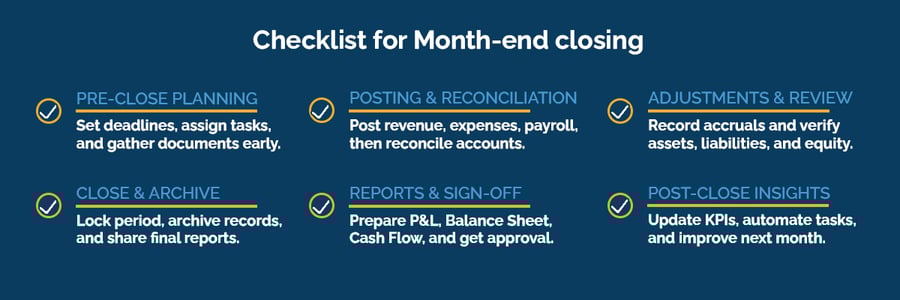
1) Pre-Close Planning: Prepare Before the Month Ends
A strong month- end close always starts with planning. Before the month ends, build a clear schedule with deadlines while assigning responsibility for each task. This reduces last-minute chaos. It’s also important to communicate the closing process to all departments. Especially AP, AR, payroll, and inventory teams, should know when their documents are needed.
Collect essential documents early to avoid delays:
• Bank statements
• Invoices and receipts
• Credit-card feeds
• Inventory and fixed asset updates
Confirm the cut-off rules for what belongs or doesn’t in the current month. Finally, keep a simple checklist for recurring entries. Pay attention to accruals, payroll, and depreciation ensuring nothing is missed. Good planning makes the month- end closing process much smoother.
Also read: What Are SG&A Expenses? How You Can Optimize Cost and Stay Audit Ready
2) Transaction Posting & Reconciliation — Core of the Checklist
Once planning is done, the next step in the checklist for month - end closing checklist is to ensure that every transaction is accurately recorded. This includes posting and reviewing all activities for the month, so your books reflect the true financial picture. Make sure you enter:
• Revenue and sales
• Expenses and vendor invoices
• Payroll
• Cash receipts
After posting, reconcile every account to confirm that your balances match the bank and internal records. Focus on:
• Bank and credit-card statements
• Accounts receivable and accounts payable aging schedules
• Inventory, if applicable
• Prepaid expenses and accruals
Finally, look for exceptions or items that do not match and clear them before closing. Fixing small issues now prevents bigger problems later and keeps your financial data accurate and reliable.
3) Adjustments & Balance Sheet Review — Ensure Correct Period Matching
Once the main posting and reconciliations are complete, the next step in the month- end closing checklist is to adjust and review the balance sheet. This ensures that every entry is in the correct period, and that your financial statements accurately reflect the business’ position. During this stage, accruals, deferrals, depreciation, amortization, prepayments, and any asset disposals are recorded.
The balance sheet is then reviewed to confirm that assets, liabilities, and equity accounts are accurate. If the company has intercompany transactions, these are also checked, while differences are cleared. All adjustments are documented carefully, maintaining a strong audit trail. This makes the close accurate, transparent, and easy to verify later.
4) Financial Statements & Leadership Review — A Key Step
After adjustments are complete, the next stage in the month- end closing checklist is to prepare financial statements and review them with leadership. This step turns all the recorded data into clear reports. The finance team prepares the Profit and Loss statement, Balance Sheet, and Cash Flow Statement to present the month’s performance.
5) Close the Books & Archive — Final Step
At the end of the process, the goal is to prevent late or incorrect entries. Ensuring everything is properly stored also matters. The final step in the month- end checklist closing includes:
• Lock the accounting period so no new transactions can be added or changed
• Archive all supporting documents, including:
Financial statements
Reconciliations
Journal entries
Working papers
• Distribute final reports to leadership or other stakeholders
This step secures financial records, maintains a clear audit trail, and ensures everyone has access to accurate, approved information from the recent close.
6) Post-Close Insights — Turn Closing into Strategy
The final goal is to learn and improve month after month. After closing the books, update KPIs such as working capital, cash flow, and DSO/DPO. This evaluates business performance and uncovers strategic insights for better decision-making. A brief post-close review is also useful. Discuss tasks that can be automated for the next time. Finally, refine the checklist for the upcoming month to improve efficiency going forward.
Conclusion
Modern finance teams increasingly view the month-end close as more than a compliance routine. It's a core practice that powers faster decisions, reduces risk, and creates clarity. According to sources in 2025, about 50% of finance teams still take six or more business days to close. Many spend 20–50 hours monthly on bank reconciliation across multiple systems.
Companies that adopt a well-structured checklist for month- end closing, along with automation, report dramatic improvements. Fewer errors, faster closing cycles, and stronger audit readiness can be key going forward.
What this means for business leaders? A disciplined close process gives you reliable, up-to-date financial data, clear cash flow visibility, and confidence. This is critical when you’re scaling, raising capital or expanding operations.
Why Tarsus?
If you want to skip the pain of long close cycles and scattered books, that’s where Tarsus steps in. We build and manage finance systems, run month-end closes, prepare financial statements, and provide clean dashboards. You spend less time crunching numbers and more time building your business.